Saturday, 30 November 2024

What's wrong with us?

 Once upon a time in a galaxy far away, I used to write a monthly magazine column designed to tell readers they're wrong about everything. The editor must have really liked me, because the accepted practice is to do quite the opposite; people like to read things and think “Yes, I agree with that, that's my experience.” But somehow I didn't get fired and it kept me gainfully employed for years...

Now, in another universe, I find myself helping a lot of people with their health, fitness and nutrition, and I promise that I don't in real life tell them they're wrong all the time. 'Cos I need the money. The trouble is, there's too much information out there at your fingertips, and while it may mostly be correct in a very literal sense, it's not always really helpful. And everyone is pushing their unique agenda in the hope that it makes sense and you buy in.

Here are some awkward facts. 

BMI is nonsense. Apparently I'm overweight, but I'm 13% body fat and I can see my abs in the mirror.

10000 steps a day is a nice goal, but 5000 decent steps is a better one. If you're not getting your heart-rate up, getting a bit out of breath, you aren't really achieving the cardiovascular benefits that the step-count fans are raving about. 

You may think you know how many calories you're imbibing, or how many you're burning, but you probably don't. It's really hard to measure, so if you used some simple online calculator or app, you could well be miles away from the truth. If you have a wrist based device, that's probably wrong too. In one meta-study of 65 different articles, for energy expenditure, the mean average percentage error was >30% for all the brands, showing poor accuracy across devices. That's awful.

It's 90% nutrition and 10% about the exercise. You can't outrun a bad diet. But that doesn't mean you can 'not do the exercise.'

Shameless plug. Hiring a personal trainer can significantly enhance your fitness journey, providing customized programs, expert guidance, motivation, and support. Whether you’re a beginner trying to get started or an experienced athlete looking to take things to the next level, a personal trainer can be a valuable ally in achieving your health and wellness goals.

Monday, 30 September 2024

Soul/Mega Firefly XS Kid's Slalom Kayak


 So, we've got out for a little paddle in the Soul/Mega Firefly XS, and here are some first impressions.

It's being marketed as a slalom trainer for kids, but it doesn't look much like a slalom boat. Since Soul also make a plastic kids slalom boat that looks exactly like a slalom boat (the Angel), we asked the designer Corran what his thinking was.

“The Angel, I was still thinking slalom boat, shrunk down. The Firefly I’ve come at from another angle. Make a boat that will allow kids to paddle slalom. Most kids are coming out of modern plastic kayaks and those are all planing hull. So this is a planing hull so it paddles the same way. It’s a familiar feel, making the transition back and forth from plastic to slalom easy. For its width it’s shorter and has more rocker than a normal boat, and ironically that’s what the new rule change coming in 2 years will effectively do. Shorter and more rocker makes it predictable and easy to put where you want it to be.”


So... it doesn't look like a slalom boat and it isn't a slalom boat; it's a whitewater boat that's great for learning slalom skills in, but probably also a bunch of other stuff as well. I thought the Firefly looked very like the Particle Accelerator, a fast adult kayak predominantly designed for kayakcross and extreme racing, but also a super playful and sporty boat for fun that can do freestyle tricks. In fact I confess I tried to get in it myself. Man, if I was a couple inches narrower I would throw this thing around like a rag doll. Anyway...
Soul Particle Accelerator

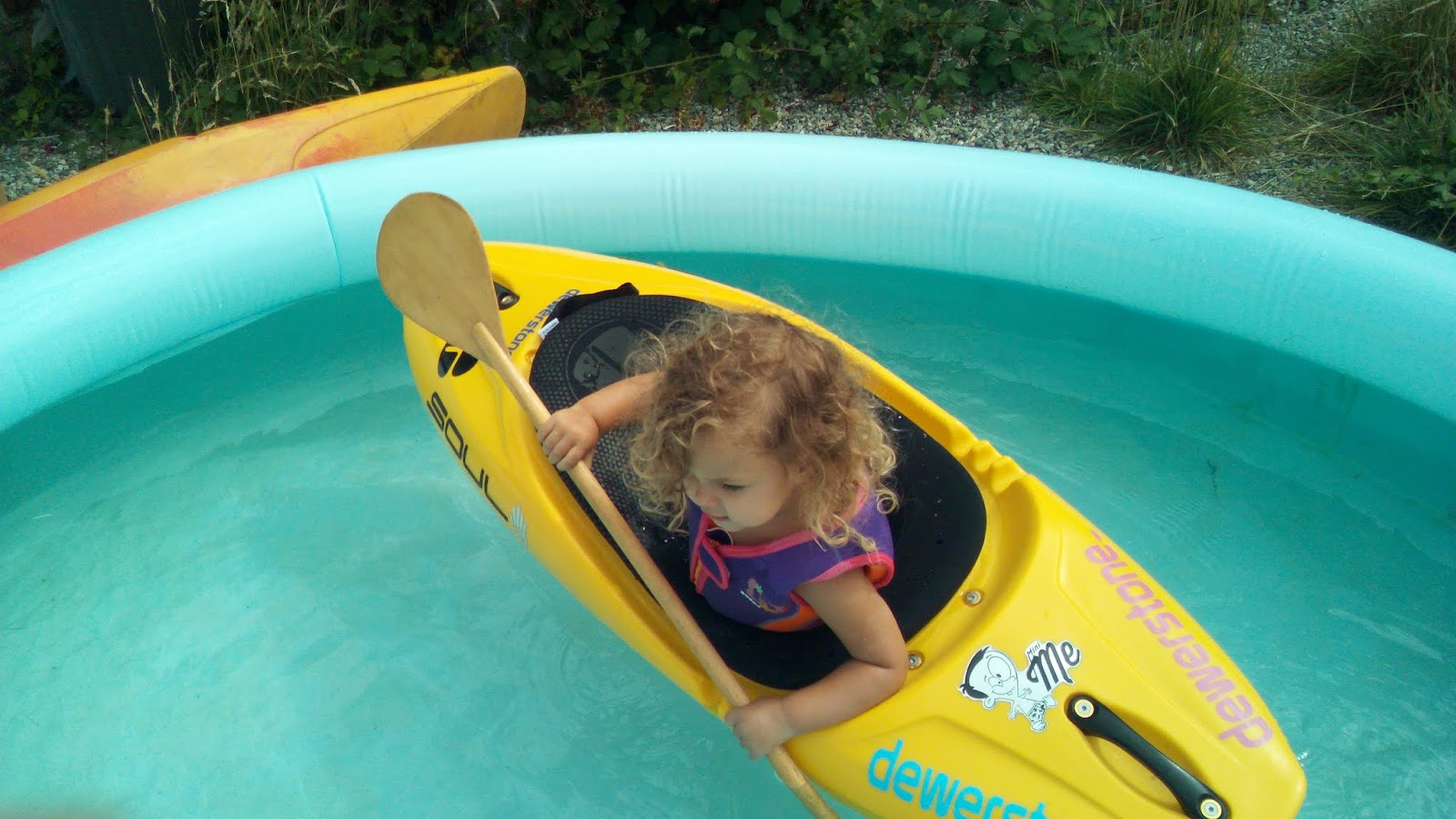
8yr old Elsa knows nothing of Particle Accelerators. Neither does she need a boat that blunts, cartwheels and spins, but she may come to appreciate that later. For now she thought it looked approachable, and was pleased to discover that it doesn't feel as if flipping over is imminent. These are the priorities of a child. And colour...

Elsa: Why is it orange?

Me: It's a demo boat. They're all orange. My F-Bomb is orange too...

Elsa: That's horrible... Why do they make them like that?

Me: Maybe so they are easy to spot when people are paddling them. Or maybe so no one will steal them...

Elsa: Hmmm... At least the cockpit is blue. But that will be covered up. It's bad thinking.

Me: Just paddle it OK?

The funny flat bit at the front of the cockpit rim caught my eye immediately and I assume it is a cunning design to make it easier for children to pull their deck. For safety we use a ludicrously loose deck; it's literally just draped over the cockpit rim. Its purpose is just to stop water splashing on Elsa's legs, which she hates. If she tips over it will just fall off.

Similarly I thought the seat looked really pro and excellent for being located in the boat, but Elsa didn't like it because she plonks herself down in quite an undisciplined fashion and hurts herself on the pointy bit at the front. I think a foam seat might be better for kids. Or a brain transplant.

On receipt of Elsa's feedback, Mega informed us that they will change out the seat for future boats.

The slalom style flush grab loops look really pro too, but we tied some webbing tails through them because grabbability/krabbability (definitely a word) is more important than not hitting poles or getting hung up in trees, when you are eight. And I will always have to tow her home. Mega tell us that they are bringing a new handle design to the production boats - this will probably address that issue.

So, onto the water. Elsa can paddle her plastic Minime playboat in a straight line without a skeg, so she set off confidently in the Firefly. Only to find that every now and then it kind of veers off into a turn that is clumsy to recover. THIS IS A GOOD THING. I remember my first slalom boat at age 15, and how frustrating it was initially that it did that, but you get over it pretty quickly. It's a function of a boat being good at carving turns. You just have to catch it before it kind of oversteers into a spin. After half an hour (a stressful half hour) of me very gently trying not to let her get annoyed and bail out of the mission to play on the swings, Elsa could keep the boat pointed at a distant landmark, or spin 360 and arrest the spin pointing right back on target. Directional instability = manoeuvrability but requires some paddler ability. OK.


The wobble test was also a success. The boat feels pretty stable (I assume, I can't fit in it), but Elsa happily rocked it from one edge to another which means that when she wants a bit of lean in her transitions she will be able to do it. She doesn't weigh much more than 25kg, so it's hard to get an edge on unless the boat is designed this way.

We crossed some eddylines but actual rapids will have to wait for another day. I was pleased that Elsa didn't get uncomfortable on the journey, and could get out of the boat on her own when we got back. Winning so far.

The boat is made in the UK by Mega Performance Kayaks, and you can get it here...

Sunday, 24 March 2024

The Afterburn Effect of Exercise

It's much talked about, and it's alleged that many extra calories are burned. But is it real? If so, how can we get it? And is it even worth it?

The exercise afterburn effect is a phenomenon that occurs after completing a workout or physical activity. It is an ongoing elevated rate of calorie expenditure that may continue for hours or even days after exercise. This phenomenon is more scientifically known as Excess Post-exercise Oxygen Consumption (EPOC). The afterburn effect has been studied extensively and found to be both significant and beneficial for individuals seeking to lose weight or increase their overall fitness level. In short, when an individual engages in physical activity, the body uses up its reserves to fuel the workout. Therefore, after the exercise session, the body must replenish these reserves. As a result, recovery requires the body to burn more calories than if the activity had not been undertaken. This extra calorie expenditure is called the afterburn effect.


The body needs extra oxygen to replace the ATP (the front line of energy supply) and muscle glycogen used during the workout to recover to its normal resting state. It also restores the blood oxygen level and (somewhat counter-intuitively) has to work to lower body temperature. Oxygen/energy is required to mobilise protein to repair the damaged muscle tissues. The more oxygen is needed to restore the body to homeostasis, the more calories will be burnt post-workout.


The afterburn effect is generally considered to last anywhere from 15 minutes to 48 hours, depending on the intensity of the activity. High intensity interval training (HIIT) has been found to have the most significant afterburn effect, with some studies showing that the calories burned can be up to 15% greater than those burned during the activity itself. Studies do not tend to extend beyond 48 hours because the gains are small and hard to measure after that, but exceptionally, this study https://pubmed.ncbi.nlm.nih.gov/20886227/#article-details pursued results up to 72. It was reported that a one-set high-intensity resistance training session was shown to have the same effect as three sets in elevating resting energy expenditure in overweight college males tested. This effect was measurable all the way out to 72 hours.


The afterburn effect can be beneficial for those looking to lose weight, as it can help increase the number of calories burned throughout the day. It also helps to improve an individual's overall fitness level, as the body must work harder to replenish the energy stores that were used during the activity.


In addition to weight loss and increased fitness, the afterburn effect has also been found to have other health benefits. For example, it is believed to increase the production of testosterone and human growth hormone, which can help to build muscle mass and improve bone density. It can also help to reduce stress, enhance the quality of sleep, and reduce the risk of certain diseases.


Although the effect may be exciting, afterburn should not be confused with the thermic effect of increased muscle mass. Individuals with more lean muscle do burn more calories, even at rest, than less muscular folk. Whereas people who regularly train steady state cardio or endurance workouts may even burn fewer calories at rest because their bodies have been honed to greater heights of metabolic efficiency! The afterburn effect refers to the calorific cost of replenishing the oxygen debt of exercise, not the calorie burn of muscle mass or other normal resting physiological functions.


This study https://pubmed.ncbi.nlm.nih.gov/17101527/#article-details found the additional post-exercise calories to be in the region of 6-15% of the calories used by their subjects in the actual workout. They commented that the EPOC effect appears to increase linearly with the intensity of the exercise. In the aerobic workout zone, 60-65% of HRmax, we expect that the afterburn effect accounts for 0-5% of the calories used in the actual exercise. For more strenuous workouts, 75-85% of HRmax increases to 5-10%. High intensity training, whether resistance, interval or endurance, boosts that figure to 10-15% of workout calories!


There are no disadvantages to burning a few extra calories over and above what we set out to do in the gym or on the trail, but keeping the value of afterburn in perspective is essential. A 500kcal workout is going to result in an extra 75kcals burnt post-exercise. In this sense, optimism that EPOC plays an important role in weight loss is unfounded, especially since, as detailed above, achieving even that 15% figure requires a level of training intensity that is unlikely to be tolerable to a less athletic individual! However, every little helps; all calorific deficits result in weight loss to a lesser or greater extent, and reduction of excess weight has been shown to contribute to the quality of life as well as a marked decrease in all-cause mortality.


However, the duration and magnitude of the EPOC generated by high-intensity resistance training suggest that it would be a valid strategy as part of a weight management program for individuals who would commonly have opted for low-intensity, steady-state activity.


"A 15–20 minute HIIT session elevates your VO2max – which enhances aerobic endurance fitness – the same amount as 60 minutes of actual endurance training whilst torching a similar amount of calories" (Helgerud et al. 2007; Little et al. 2009; Tabata et al. 1996).


# Use a heart rate monitor with a suitable app to measure your exercise calories. Chest strap monitors are much more reliable than wrist devices.


# Make sure you enter your correct age and weight in the app. Otherwise, the results will be wrong.


# The harder you push yourself, the more bonus calories you'll use up. But don't get so obsessed with calorie burn that you train too hard or too long and cannot face it tomorrow!


# Rest/recovery and sleep are vital for the repair processes that use extra calories. Don't burn the candle at both ends!


# Use a calorie counting app to track your nutrition. There is little point in knowing what you burn if you don't know how much you're eating.


# Don't try to lose more than 1-2 lbs a week. You will have no energy, and your weight will bounce back up later. You might also be exposing yourself to health risks that are more severe than those associated with weight.


# Remember, the only exercise program that works is the one you can stick to! So count the calories, do the maths, but don't be so focussed on that last 100kcals that you stop having fun!


The afterburn effect is a beneficial phenomenon that can help individuals lose weight, increase their fitness levels, and improve their overall health. However, it is essential to note that the maximum afterburn can only be achieved with medium to high-intensity exercise and will not occur with low-intensity activities. Therefore, engaging in HIIT or other high-intensity activities is recommended for those hoping to take advantage of the afterburn effect. However, always seek professional medical advice before embarking on such a program.


Check back soon for a rant about why you don't know your BMR or how many calories you're actually digesting. In the meantime, don't forget to breathe!

Friday, 22 March 2024

Another Fine Book

The long and twisted survival book saga continues; this latest iteration of a thing I co-wrote in 2003ish has just appeared on my Amazon page. It's not the same old thing though. 

The story is that in 2021 the publishers decided to dismantle that book and publish two separate ones. I rewrote the the urban, travel and combat parts which were published as Urban Survival and Antonio did the bushcraft and wilderness skills which incidentally features me spearfishing on the front cover. 
 

Now, to my surprise, they've stuck the two back together again as Survival, A Practical Guide and I wait, patiently watching the letterbox, for it to fall through my door!

Friday, 1 December 2023

Winter is, ahem... winter.

If one more person tells me that "Winter tyres make no difference on ice" or that "It's not worth buying winter tyres for three days a year!" I swear to you, I'll... well, I won't do anything, really. I'm already writing this strongly worded article on the subject, and that's about as aggressive as I get, frankly. But I do pride myself on smiling sweetly (most of the time), and saying 'Riggggghhhhttt..." when I feel like yelling "Are you a f***ing moron? Shut up!"

Still, people need to be disabused of their delusions sometimes, so here we go.

Winter tyres are for winter. They aren't special magic tyres for Arctic conditions. They are for winter - anytime the temperature is 7ยบC or less, even on a dry road, you'll be much better off on winters. The tyres most Brits have on their cars are called "summer tyres". They aren't "normal tyres" or "road tyres", they are for summer, to maximise grip on warm road surfaces. And that means warm like Europe. I looked at the average max/min temperatures for Birmingham and conclude that we are better off on winter tyres October through May (inc) so if I could only afford one set of tyres, I'd be on winters year round.

Now, that ice thing. Here's a video:
If you get up to go to work or drive your kids, and it's slippy, or just damp, or it's 7ยบC, your car will steer and stop a lot better on winter tyres. If you crash your insurance excess will be probably be more than those tyres would have been. But it's not about you. It's about not crashing into an innocent pedestrian, or damaging other peoples property. Or clogging up the roads so that the trucks (that might otherwise have managed just fine in the snow) can't get to the shops with MY food. Selfish, is what it is.

By the way, by winters I mean, actual winter tyres. As per the video, all-season tyres don't even come close. Neither do M+S (mud and snow) tyres, or the big chunky tyres that came with your 4x4. The latter two are strong in some conditions, but do not have the  general cold-weather stopping and steering performance of winter compounds.

So, four wheel drive. We need to talk about this. Four wheel drive can be a massive advantage in slippery conditions, or it can be a liability. If you're driving a Land Rover or 4x4 jeep or pickup truck like a Hilux then you are probably going to be doing better than most, even on shonky tyres. Same goes for a 4x4 car designed for rallying like the original Audi Quattro, the Mitzi Evo or Subaru Impreza, Lancia Delta Integrale, Sierra/Escort Cosworth, etc. Other 4x4's, not so much. Most of the other luxury 4x4's, the 4x4 SUV's and other random things, they don't have the right kind of technology for really slippy conditions. Basically if your 4x4 doesn't have the ability to lock (or seriously lim-slip) its diffs, including front to back, you're just going to get stuck the moment one wheel loses traction. Which is kind of worse than a two-wheel drive car.
A soft-roader, faux-by-four, or as a friend put it, "Four by f-all"
We did an experiment with a highly rated 4x4 SUV on full winter tyres and it still couldn't make it up the road as far as my old Ford Transit could with RWD and no limited slip diff!

If you don't understand what the hell I'm talking about above then you probably don't have the right kind of 4x4 for the snow and ice.

Having said all that, here's a disclaimer: winter tyres mean more grip in cold dry weather, in cool damp conditions and in the snow, and on ice. They are not a brain transplant or a cloak of invincibility. Do not drive like a twit.

To recap, here's a short list of things that don't seem to work terribly well in the winter:

Summer tyres
All-season tyres
M+S tyres
4x4 SUV's
Driving fast
and the brains of non-snow-dwellers, apparently.

Friday, 7 January 2022

The mainstream news media is usually wrong. But it's the best we have.

The mainstream news media is usually wrong. We know this. Well, I do, anyway - because every single time I've read or heard an article that I had insider knowledge of (like, I witnessed the event myself, for instance), the coverage has been woefully inaccurate or downright wrong. Every. Single. Time.

Not a scientific study, I realise, but the consistency of my experience leads me to believe that I cannot (or should not) treat any news report as gospel truth. It's just way too unlikely to be right.

Enter the "new" news. Social media has spawned myriad dot-com news pages that the cynical and the conspiracy theorists love to share, because they appear to be the antidote to the dry, old and reputedly biased trad media. These pages, according to popular belief, are a breath of fresh air, telling us the truth behind the lies and blowing away the smoke and mirrors of the bastard political elite.

Bollocks.

I'm not talking about stupid memes that people share because they reflect their own political agenda. Those are all bollocks, but no. I mean serious sounding websites, usually with "art", "science" or "health" in the title, which purport to educate and inform. I have bad news for you...

Many, if not all of those articles are written by pillocks like me. For next to no money. With little or no regard for fact-checking or in fact anything except hitting the word count in the shortest possible time.

Back in the day when I was a bit desperate for cash, I would take any writing gig I could get, so I stumbled across these "agencies" that provide writing work to freelancers. You have to pass an infantile writing test and then, boom! The editor emails me a list of subjects:

Deodorant - 800wds
Space Exploration - 700wds
Is the taxpayer footing the bill for the Royal Wedding? - 1000wds
The Large Hadron Collider turns up another new particle - 500wds
The world's banks are really run by the Rothschilds - 700wds
I made these up, but you get the picture...

You have about two days to write ten to twenty articles and you get paid a set amount for the lot, if and only if they all conform to a set of guidelines, which was a bigger document than the contracts for any of the books I've written! The point is that I know nothing about these subjects and just Google quickly and write them quicker still; I worked out that if I wrote as fast as I can I could earn about £3 per hour. The editor pastes the words in and the content goes out as informative material. But, with the best will in the world, it's crap.

The purpose of these articles is only to get you to the site and expose you to advertising. That is almost exactly the same business model as a newspaper, but the perpetrators do not care at all about accuracy when it comes to social media. If a few people rubbish the claims and start an argument that just means more exposure and more ad clicks.

If I was writing for The Independent or something, they'd only use me for work that I knew something about. Like kayaking. Or snow. These "agencies" would just send a list of seemingly random subjects to me and say "Do it."

I realised pretty quickly that I didn't want to do this work, but there are a lot of unemployed, stay-at-home parents, wannabe writers, or just desperate people who are still doing it. I suppose that by not sharing this nonsense on social media, we are potentially depriving people of their income, but for the greater good I suspect that perhaps we shouldn't.

Monday, 1 November 2021

The Wizard Stick

 Here is the NEW Wizard Stick paddle from Mega:

http://www.surfkayaks.com/product.php?productid=17774


Disclosure: I am a Mega Team Rider, and I was given this paddle to review. However, like the magical sitar from the movie Moulin Rouge, I only speak the truth. The words in italics below are the official Mega claims. The rest is me.


Mega are renowned designers and laminators of sexy composite boats, most famous for their surf kayaks (market leaders since 1991), but also sea kayaks, open canoes and even a playboat! Now they are trying their hands at the magic of paddles. Weighing in at just 850g, the new Wizard Stick is certainly a force to be reckoned with. Mine is carbon blade with sky shaft (history lesson about pole-vault poles, Google it), and I've gone for a length that I can use for surfing (but it's a bit long) or sea kayaking (but it's a bit short) or whitewater, for which as you might guess it's perfect! Medium blade (745cm/sq).

I've snapped paddle shafts before, including a sky pole; one over the deck of the boat 'cos I landed flat from 40', and another by jumping on it. But unless the shaft is damaged already, a more likely outcome is a catastrophic failure of the blade or joint.

"The carbon paddles are made from carbon fibre multi-directional prepreg laminate."

OK.

"The shafts are 30mm and inserted into a 70mm long sleeve in the neck of the blade for extra strength."

OK.

I can't tell if they're strong, but they look strong. The joint is a bit bulky because the designers have erred on the side of Mega-strong, and the blade looks as if an inch-thick pile of carbon fabric has been put in an autoclave and squashed paper-thin under Mega-tons of pressure. Which it probably has! (See what I did there?)

Hmm, no dihedral... Is this even gonna work? Dihedral is the principle of shaping the drive face like the convex side of a spoon rather than the side you eat from. The slight loss of power stabilises the blade and prevents flutter. The only paddles that don't have dihedral are usually in slalom or other power-hungry applications, and the immense forearm strength of the athletes is relied upon to control the flutter. Until they retire with wrist and elbow injuries. No... we like dihedral.

"The blades are spoon shape tip to tail and flat across the middle plane with a thin profile to bite the water efficiently with no flutter."

Are they now? This doesn't sound right. So I took 'em paddling. The only way to be sure...

I have many sea kayak paddles, from G-stick to long touring Euro blades, but I like to go out fitness training in my Inuk (fast sea kayak) with short slalom style paddles just for the workout it gives me. Enter the Wizard Stick. I put a few miles in on the Tamar estuary where I live. There's no flutter. There's less splash and more power than with my slalom paddle. What is this witchcraft? Damn...

"Very light - almost all flex has been eliminated from the blade, so the power output is immense."

This is true. There is flex in the shaft, though, just the right amount to give the paddle that "living thing" feeling like a wooden paddle and protect my ageing joints! I love sky shafts and have done since Werner first used 'em way back when. They're incredibly strong with just the right (minimal) amount of flex, and the ovals for the hands are much nicer than most. Speaking of ovals, the Mega paddle seems to have less than usual, which worried me until I used them and it felt great!

One problem I've had in the past is with the Skypole having a greasy feel so that I had to use surfboard wax to give me a confident grip. The Mega one is slightly different, with a matt finish almost as if it's been sintered. No grip problems here.


OK, so it's my new favourite paddle. But I haven't exactly tried it in its element. I put the paddle away and kept checking the surf forecast for a day I could a) surf and b) take decent photos, but another opportunity came up first; a massive rainfall on Dartmoor brought the rivers up big, notably the Dart. I was pencilled in to do a boat test, so after the school run, I found myself bowling across the moor with whitewater boats and the new fave stick. 


In my head, I was going to get some photos of the boat doing its thing and some of the paddle for this review. With snapper Kate on the bank with a DSLR, I seal launched into the pumping river, painfully aware that I hadn't been on whitewater for a year (or in this boat ever), and a strange thing happened. I forgot about the paddle. Completely. I was thinking about the somewhat general-purpose boat, how to use it, how to get it to surf a wave that most people can't surf even in playboats, and I forgot I had a new paddle. I think this is the best accolade possible. It just works. And I did paddle the surging floodwaters, and I did surf the difficult wave, and the paddle didn't make me adapt or think or anything.


So, perhaps I'm biased or just lucky (probably), but I think it's perfect.

It's also available with glass blades, carbon shafts, bent shafts, bla bla... But mine is the best. End of story.

I will use it for surfing when the right day comes. But in the meantime, I'll use it for everything I can!


Friday, 23 October 2020

Sorry about the radio silence...

It's been a while! I decided I would shift the emphasis of this blog to my then embryonic personal training business, and then there was a toddler, and then Covid-19. I seriously underestimated how time-consuming toddlers are, especially when you're stuck with 'em 24/7. But no regrets. It's been great to be able to spend so much time with her.

Now, onwards. I'm writing some PT and personal development stuff; it's very progressive and closely aligned with my philosophy, one that regular readers are probably familiar with. If you're new to my ramblings, it may or may not be for you. The next post might be called something like "Your goals are not the answer".

Watch this space, and in the meantime, don't forget to breathe...

Wednesday, 27 May 2020

Soul, baby...

It's past Easter, and in the northern hemisphere that means more people start to think about the upcoming watersports season. For me and my whitewater tribe there's no off season - in Britain, unusually, the whitewater boating happens in the rainy (ten) months of the year, most of which are concentrated in the autumn and winter. But for most people, now is the time. Now that we've got the snow (!) out of the way, it's the season to dust off the toy cupboard and realise that the correct number of boats to have is always n+1, where n is the number you have already...
I'm excited about the new crop of slicey playboats, like the Mixmaster and whatever Shane's called the LL boat I said he should call Slicey McSliceface. But I'm getting a Soul 303 and F Bomb, for reasons that may become clear if you read to the bottom.
My daughter, on the other hand, is three years old. She knows nothing of slicey, of three-dimensional hydro-gymnastics or anything else of that ilk. She just wants to float in wonder, look at ducks, and bounce over little waves shouting "Wheeeee!" So I got her the Terrible Two (tandem whitewater kayak) and the Minime (toddler upwards kayak). Here's my experience of them.
I knew the Minime was going to be small but I didn't picture quite how small. It's tiny! But as soon as my 2yr old got in (she got it for her 2nd birthday) I could see that she was only just big enough to paddle it and won't grow out of it for years, maybe not until she's eight. It is a beautifully made boat with great styling and graphics and simple yet effective outfitting drawn from Corran's own experience with his kid. It looks at first glance as if it's a playboat, with a planing hull and rocker breaks, but the overall volume and its distribution is more practical than that. I reckon it will look after the little ones when they finally transition to solo white water boating. The really magic feature though, is the flip down skeg. At the flip of a switch the long skeg swings straight down and keeps the tiny ones, who initially paddle entirely in sweep strokes, from the frustration of zig-zags. The skeg kicks up easily if they paddle into shallow water.
It's hard to picture what kind of paddle a little person is going to need so we got a supercheap (£7) plastic thing online to get started, knowing that it can break down into oars for her raft or be modified to make a better paddle. It was too long and too thick so I transplanted the blades onto a bit of plumbing pipe and we continued to experiment at low cost. Currently she has a wooden squirt-stick style paddle I made out of a broom handle and some plywood!
Initially though, she was much happier going out in the tandem Terrible Two with Daddy. The TT is very different from whitewater doubles like the Topo Duo / Dynamic Duo. The front cockpit is the same as the Minime, which works as a big open cockpit for a toddler but will soon work to brace and roll with a spraydeck on as they get bigger. The volume has been distributed accordingly. Because of this, it doesn't paddle like the Duos. Those boats are reminiscent of end cockpit C2's with a big effort by both paddlers required to make the moves. In the TT the boat turns around a point somewhere under the rear paddler's knees, which means that it can be controlled entirely from the rear with good effect. As someone who paddles pretty much in a constant bow rudder/draw/scull//pull fusion on rapids, I appreciate that a lot. I'd be happy to put a cockpit cover on the front and paddle grade 4 in this boat. When the munchkin is in the front it makes little difference to me - I just wouldn't take her down big rapids for her sake. Grab handles for the front paddler are a cool feature though. If she gets alarmed she can drop her paddle and grab these - Brace! Brace! Brace!
On the side is what I call the "suitcase" handle. Basically I can just pick up the boat and carry it like a suitcase. Which brings us to weight. It's not heavy. The yellow ones are a bit lighter than the others. The TT comes in at 19kg. That's awesome. Because realistically I will be carrying that and all my kit, plus the Minime in the other hand, probably, whilst my babygirl toddles alongside.
Finish. Most plastic kayaks look a bit disappointing, in my view. Like something that fell out of a Christmas cracker, but with a mysteriously stratospheric price tag. These boats are quite simple but so nicely finished, with a mix of shiny and textured areas, great 3d graphics, and handles and fittings that look very robust and high quality. The moulded outfitting for the standard seat is attractive and functional. The kid's seat looks a bit simple and thin/cheap, but it's in effect a baby power-seat, and doesn't need to be heavy to support a child's weight, and allows us to stick foam pads in there to stop small people from falling to one side of the boat. It adjusts fore/aft and up/down without tools.


Other brands are available. They just don't make boats for toddlers.

Monday, 5 November 2018

Press-up Challenge

Press-ups (or push-ups), 200 per day. Simple. Earlier in the year, inspired by something I saw online @gymfcks I thought I'd pump the pecs and sort out my lower back lordosis in one fell swoop; spring was coming, planks are boring, and this is a great way (for me) to get through the day; interspersing it with endorphin-boosting intervals.

If you'd like to join me, just go for it! Film each set on your phone or action-cam (with or without toddler hindrance) join 'em together and speed it up - tag me @itsmattos on Instagram, Twitter, FB or whatever you have! Looking forward to seeing other people's sets. Any type of press-up - you might be a minor deity doing one-arm push-ups on a TRX strap or a starter for ten doing them on your knees. I'm going for a mix of wide, narrow, assymetric, incline and decline - doing about twenty on the hour through the day. It works wonders for my mental health and it can't hurt on the fitness front, either!


Saturday, 23 December 2017

Sitting, standing, kneeling...

Canoe & Kayak UK - photo © Pierre Mellows 
Only because I  found it on the internet, to be quite honest, but this lovely photo by the talented Pierre Mellows was shot for my first foray into writing about SUP for print. Interesting composition works really well here (it's a DPS so there's a fold down the middle), and the canoe shot is not what anyone expected. Thus lulling the canoeing and kayaking readers into something or another and circumventing the expected backlash from the anti-stand-up-community... maybe. Why people can't all play nicely together is beyond me. Sitting, standing or kneeling, it's all fun...

Saturday, 16 December 2017

Dynamic Duo Paddling

I thought it would be a marvellous idea to take my buddy Mitch down some rapids in a double kayak. He's been kayaking before, of course, but never on moving water. And I've never paddled a duo with someone in the front who weighs as much as me (or a bit more even)...

So, with very high water levels on the Dart (through the third arch if that means anything to you) it was always going to be an adventure.

Safety boating, filming, commentary and wind-ups by Steve Whetman (Ugg) from Whetman Equipment

My favourite part is actually Ugg running the somewhat rowdy Lover's Leap rapid backwards so that he could film our descent. Awesome work!


Tuesday, 17 October 2017

Hammerhead Land SUP Boards

Land-based training and lots of fun!

We have UK stock of the Hammerhead board and paddle available at the new competitive price of £339 including mainland delivery and VAT. The US price is $389, but that does not include tax or carriage so this is a bargain. For comparison the only other carbon paddle we know in the UK is £129.99 with the nearest comparable longboard coming in around £220, so at a similar price but including delivery and a host of unique and arguably superior features, the Hammerhead looks pretty attractive.


Unpacking the stock and checking out the boards, Kiah liked the Natural board colour with the Sandstorm deck pad. I kinda wanted to like the Black with the Rasta pattern, but I think I have to agree. All the boards including the Ocean Blue (pictured above) look pretty cool though - the foam deck pad looks a lot more exciting than just grip tape, as well as being warm and allowing us to ride in bare feet!

Natural//Sandstorm
All the colours we have
The unique things about the Hammerhead board are its sheer size (it's much more of an SUP experience than just a normal longboard), its deck shape that prevents the paddle from fouling on the wheels, and the foam deck pad. If you want to feel that you are riding an SUP board, rather than just skateboarding while waving a stick, I don't think there is any other combo that can replicate it. The paddle is carbon with a dense and grippy rubber ball, perfect for drive as well as braking, support and slides. The paddle is adjustable too. With the massive, robust Caliber trucks and the smooth as silk 70mm wheels, we are having a lot of fun with it!

For more information or to order a Hammerhead board please contact UK Brand Ambassador Bill Mattos - mail@billmattos.com


Big thanks to Kiah from skatesisters.com Instagram @kiahskate


Wednesday, 3 May 2017

Jeans from dewerstone - practical in the extreme.

Stretch jeans were a thing when I was a kid. It didn't endure. But in a world where we want our activewear not to look like activewear (I'm using the royal "we" because I know there are MAMIL's and people who wear their gym clothes to show that they go to the gym) the concept of stretch denim actually makes a lot of sense. I wasn't sure I would enjoy wearing it though. But I do. They look like nice jeans, feel good to wear (they are quite light but I haven't ripped them yet so that isn't really a negative) but crucially they allow a lot more movement than conventional jeans.

A friend of mine who is a dancer used to wear what she called her "dancing jeans" - I think they were in fact her Dad's old jeans, and they were massive. This enabled her to do big dance moves unhindered, and I don't think she was bothered that they weren't that flattering to her svelte physique. But guys can't really employ this strategy - we don't have the waist/hips really, so big trousers actually fall down and make leg movement even more difficult. Enter the reasonably fitted but stretchy dewerstone jeans. I wear these as often as I can, and very often bust out a workout in them. Dance moves not so much.

Kind of a dragon flag/crunch combo thing... Without builder's bum... Winning...

"Now hang on a minute," I imagine you saying, "Why would you do a workout in your jeans?" And yes, perhaps that seems as incongruous to some people as wearing Lycra all day does to me. But hear me out. When I'm looking after the toddler, or at the computer, I just need to swing into action with a mini workout when said child goes to sleep or is incarcerated in a high chair. Or when I have writer's block or procrastination overload, in the latter case. Or at the pub. I don't have time to be putting on special clothes.
On another level, the fact that I can do a workout in these jeans demonstrates that they're perfect when you have to vault a gate, climb a wall, or paddle home from the pub in a canoe. All of which (and more) I have had to do in the dewerstone jeans recently, so I can confirm that they are practical in the extreme. Maybe they should be called "Life Jeans"...


What else do I like about them? The little square pocket that all jeans have, that I used to call a change pocket but maybe it's for condoms? Whatever, it's no use at all if you can't get enough fingers in to retrieve the contents. This one is perfect. Again, the stretch helps.

Subtle branding. Nice. Sizing, as far as I can tell, as expected. Colour - they don't look "too blue" straight off the shelf, but don't fade in the first few washes. Build quality - exemplary. Back pockets big enough for my "phablet" (^see dragon flag pic^ - it's in my back pocket).


Could they be better? Not really. I would prefer a button fly, and maybe a hidden zipped pocket for cards/cash so that stuff can't be lost when you hang upside down. But that's just me. Personal preference.

To check them out or buy online, go to dewerstone.com

Thanks for reading!


Saturday, 14 January 2017

Training with balls...

Two balls, in fact, a BOSU ball (wobble plate thingy) and a medicine or slam ball. Most of my SUP pals, like myself, train on sheltered flat water a lot. When it comes to going out in the wind and chop, it shows up deficiencies in the legs and core control. I've been training on the Hammerhead land-SUP for a few weeks now, but when the weather is wet, or hail, sleet and snow right now actually, I want a way to train at the gym. And I'm not in any way a fan (pun intended) of those things that are made out of a rowing machine, a stick and some string. Luckily my gym has the right equipment, but you can buy it online to use at home.

Hammerhead land training board - for more about this see here...
This video got off to a false start last week because I somehow managed to pack not the resplendent T-shirt from dewerstone that I'm wearing in the vid, but my girlfriend's size 8 vest-top from Gap. Don't get me wrong, I went ahead and did a workout anyway, but it didn't feel right to share. I'm pretty sure people were looking at me funny...

The BOSU ball is actually more wobbly than even my race board, so the legs are firing from the start. I throw the medicine ball at varying spots on the wall so that I'm constantly moving around to catch it. Catching it in one hand looks hard, but while it punishes the wrists and fingers, having the other hand for balance actually makes the exercise easier. Throwing straight ahead and catching against the chest is the hardest work - it nearly knocks me off my feet - but I like to mix it up to get the most varied and functional workout possible.

I train to heart rate (my phone is displaying that on the floor in front of me), but you can do sets of 20 throws, or timed intervals, or whatever feels right for you. I'm finding my heart-rate is up around 80% of MHR if I throw at about this rate. It spikes a lot higher with more extreme reaches and jumping type moves. So I'm getting a great cardio workout while beating up the abs, core, arms and back, and the legs are working hard at keeping balance.


You might want to start with just a football or something until you get the hang of it. A 5kg medicine ball is quite impactful. Another top tip, if you're at a public gym, is to look out for bystanders. Every time, some lycra-clad person will settle down on a mat right behind me to do some kind of yoga moves, seemingly oblivious to how much that medicine ball is going to hurt when I inevitably miss a catch. Finally, make sure you are throwing against a concrete wall. Not a plasterboard stud-wall. Oops...

PS This is not in fact my normal training T-shirt. I normally use the dewerstone Trail Tee, which has a small and subtle logo, but small and subtle is not the way for brand ambassadoring. It's a great workout tee that keeps me cool and is dry enough to wear straight outta the washer. You can check them out here - http://ss1.us/a/Vv3d4Q46


Monday, 21 November 2016

Hammerhead - First Impressions

I've had the Hammerhead Land SUP board in my garage for a couple of weeks now, but because it never stops raining I haven't used it as much as I hoped. I have, however, managed one dry outing, and have had time to formulate some thoughts on this relatively unusual activity.

Hammerhead’s unique, patented board consists of a multi-ply Baltic birch deck, real SUP foam deck padding, black 70 mm 82A density Divine Road Ripper wheels and a choice of either the Caliber 50 trucks or Gullwing Sidewinder trucks.


My first thought was "Why buy this?", thinking that going out with a standard longboard and a yard brush would give much the same experience. It doesn't. The Hammerhead has been designed to simulate accurately the Stand Up Paddling experience. And it does so. It's not like riding a skateboard - it really is like paddling an SUP. The board is vast, a completely different scale from a longboard, and you can move around on the foam padding feeling just as you do on the water. I even managed to hang ten on my first day! The special board shape is specifically to allow aggressive riding without fouling the paddle on the wheels, and it works!
Size comparison. And yes, my longboard has original 1970's red Kryptonics...
The durable rubber ball foot on the three piece, adjustable paddle provides just the right amount of grip on the tarmac. It's great for paddling, braking or support, and facilitates moves like tail-slides that I'm not quite brave enough to commit to yet! This carbon paddle would normally be around £200 on its own, but it's included in the price of the board. 

Adjustable carbon shaft to suit all paddlers.
Still thinking the board looks pretty expensive? Well, it's not cheap, but what you're getting is a very big piece of kit. Everything on it is huge. The trucks, the wheels, the deck itself. Enormous. Although, surprisingly, not that heavy. And if you think about it, your SUP board plus composite paddle probably cost not far shy of £1000. So this, with the paddle included, is a pretty affordable bolt on to maximise the quality of your water time by training on land as well.


The tail has a wedge which works like a kick-tail and helps drive slides, too.
I've got the 10" Calliber 50 (that's 50ยบ, btw) trucks, which are great for carving and jibbing around - the Gullwing Sidewinders are dual-pivot trucks suitable for serious downhill use.

If it's too windy to get on the water, or the tide's out, I can see this is going to be a great way to train, and it's a much better core arm/shoulder workout than skating. Watch this space for more when I've got some of the local rippers out on the board. Or if you'd like to get one, and you are in the UK/Europe, get it here : 


https://wishboxusa.co.uk/collections/sports-outdoors/products/hammerhead-paddle-skateboard-landpaddle-combo